
So, you’ve finally done it. You cleared a spot in the shed, convinced your partner that a 1970s Bally cabinet is "functional art," and hauled a dusty classic home. But then you flip the switch. Instead of the glorious chimes and flashing lights of Evel Knievel, you get a puff of magic smoke and a hum that sounds like a disappointed hornet.
Welcome to the world of pinball restoration, where the biggest question isn't "How do I play?" but "How do I keep this thing from catching fire?"
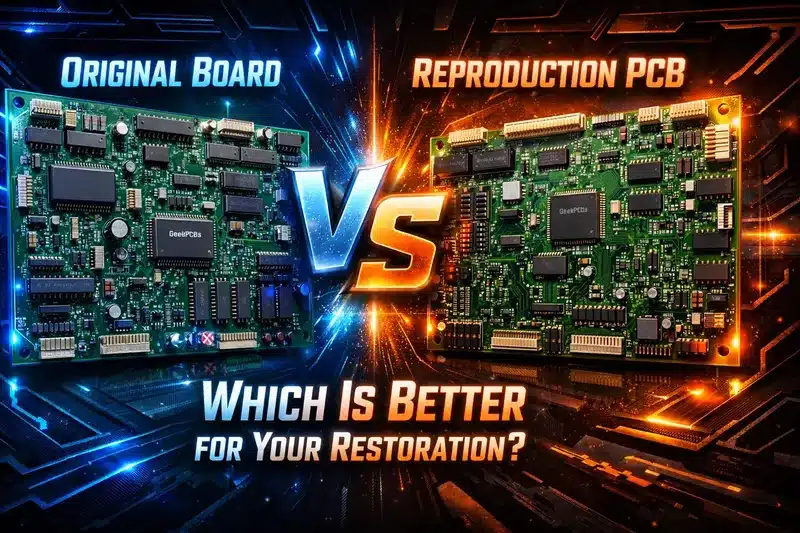
When it comes to the brains and brawn of your machine, the Printed Circuit Boards (PCBs), you’re standing at a crossroads. Do you spend hours (and many expletives) trying to revive a 40-year-old original board, or do you drop in a fresh, modern reproduction?
At GeekPCB’s, we’ve seen it all. From battery-corroded nightmares to boards that look like they were repaired by a caffeinated squirrel with a soldering iron. Today, we’re settling the debate: Original vs. Reproduction. Spoiler alert: We like things that actually work.
The 40-Year-Old Itch: Why Originals Struggle
Don't get us wrong, we have massive respect for the engineers of the late 70s and early 80s. They built machines that have lasted decades. But let’s be real: electronics have an expiration date.
Most original pinball boards were designed with a 5-to-10-year lifespan in mind. We are now triple or quadruple past that "best before" date. Here’s why your original board is probably tired:
- Heat Stress: Decades of being locked in a wooden box with incandescent bulbs is essentially slow-cooking the components.
- Capacitor Failure: Electrolytic capacitors are like little chemical time bombs. Eventually, they leak or dry out, leading to resets and hum.
- Trace Rot: Battery leakage (the dreaded "green death") eats through copper traces faster than a termite through balsa wood.
- Obsolete Parts: Finding a specific IC from 1979 can feel like looking for a needle in a haystack, if the haystack was also on fire.
While there’s a certain romanticism in keeping everything "original," there comes a point where "authentic" just means "unreliable."
Enter the New Guard: Why Reproduction is an Upgrade
Choosing a reproduction board isn’t just about replacing a part; it’s about upgrading the entire heart of the machine. When we design boards here at GeekPCB’s, we aren't just copying the old schematics. We’re fixing the mistakes the original manufacturers made because they didn't have the tech we have now.
Modern reproductions use fresh glass-epoxy (FR4) laminates, thicker copper traces, and components that can handle significantly more stress than their ancestors. It’s like taking a 1978 Ford Escort and dropping a modern, fuel-injected engine under the hood. It looks the same from the outside, but it actually starts every time you turn the key.
The Star of the Show: The Bally/Stern Rectifier AS-2518-18
If you want a perfect example of why reproduction beats "nursing the original," look no further than the Bally/Stern Rectifier Board #AS-2518-18.
This board is the heavy lifter. It takes the raw AC from the transformer and turns it into the DC power that runs your solenoids, lights, and displays. In the original design, these boards ran hot. Like, "burn your fingers" hot. The original bridge rectifiers were often undersized, and the traces were prone to lifting under high current.
Built Like a Tank (Because It Has To Be)
When you look at our version of the AS-2518-18, you’ll notice a few things immediately:
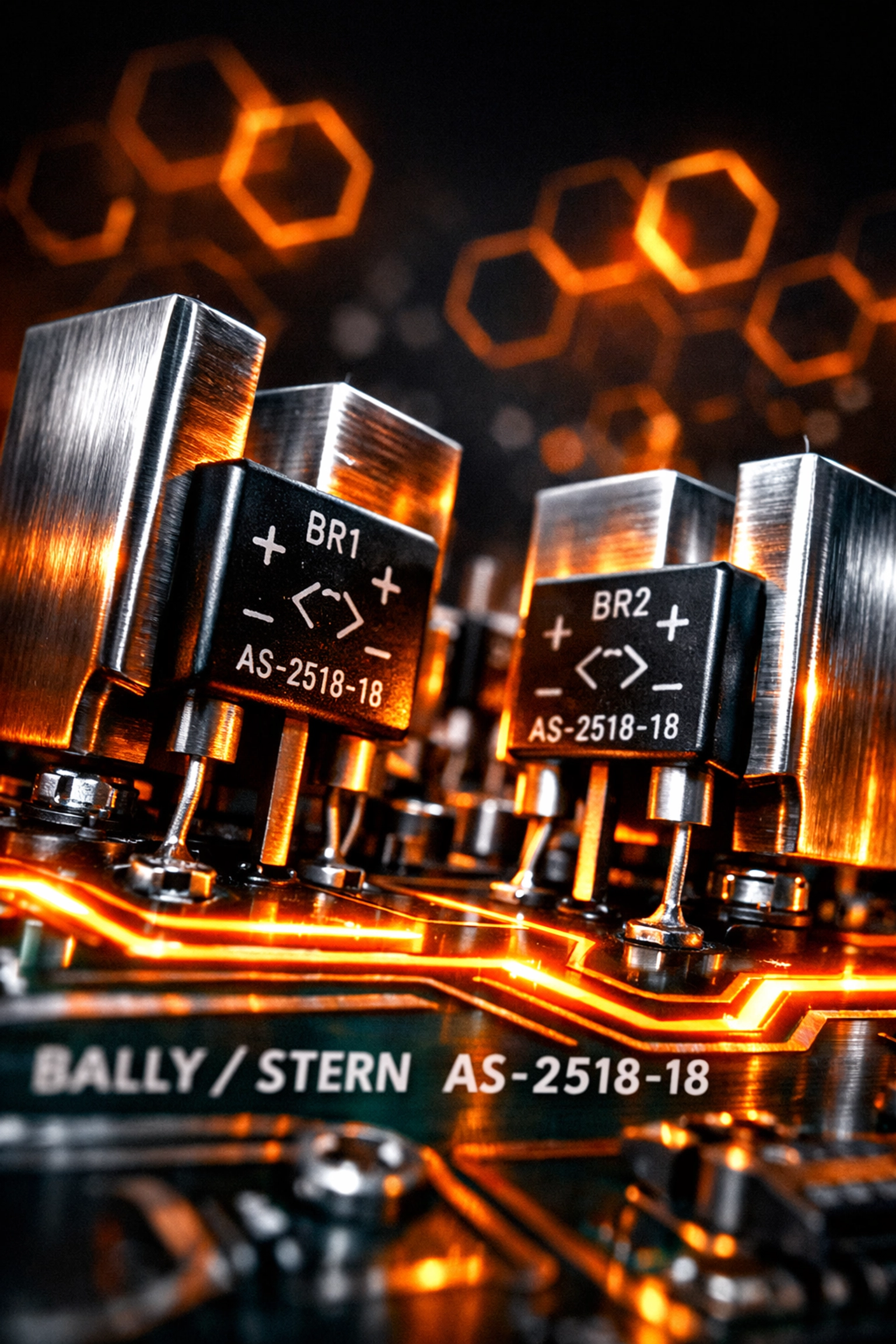
- Heavy-Duty Bridge Rectifiers: We don’t mess around. We use high-amperage (35A) bridge rectifiers that laugh in the face of your flipper coils.
- Integrated Heatsinks: Heat is the enemy of electronics. Our rectifier board features integrated heatsinks to pull that thermal energy away from the components, ensuring the board stays cool even during a four-hour marathon session of Star Trek.
- Clearly Labeled Test Points: Ever tried to troubleshoot an original board in a dark cabinet while squinting at a blurry 1980s manual? It’s a nightmare. Our boards have clearly marked test points. You can get your multimeter in there and know exactly what you’re looking at without the guesswork.
- Bulletproof Traces: We’ve beefed up the power traces to handle the current without breaking a sweat. No more charred connectors or lifting pads.
Compatibility: One Board to Rule Them All
One of the best things about the Bally/Stern AS-2518-18 reproduction is its versatility. If you’re a collector with a "type," this board is your best friend. It’s compatible with a massive list of classics, including:
- Bally Icons: Evel Knievel, Eight Ball, Silverball Mania, Playboy, and Kiss.
- Stern Classics: Meteor, Quicksilver, Galaxy, and Flight 2000.
Whether you’re jumping ramps with Evel or exploring the cosmos in Star Trek, this board provides the stable voltage those machines crave. Check out our full range in the shop to see what else we’ve got for your fleet.
Ready to Build Something Awesome? (The DIY Factor)
Mistakes happen, that’s part of DIY. Maybe you soldered a header on backward, or you realized your "quick fix" on the original board actually bridged three different pins. We’ve all been there.
The beauty of starting with a fresh reproduction, or even one of our tech DIY boards, is that you’re working with clean, un-scorched solder pads. It makes the assembly or installation process a joy rather than a chore. Plus, let's be honest, new PCBs look sexy. There is nothing more satisfying than opening a backbox and seeing a clean, green (or black!) board sitting where a crusty, brown, 40-year-old slab used to be.
The Cost of "Saving" an Original
People often ask, "Isn't it cheaper to just repair my old board?"
Sometimes, yes. If it's just a blown fuse or a single bad capacitor, go for it. But by the time you've replaced all the headers (because they're tarnished), all the caps (because they're old), and the bridge rectifiers (because they're failing), you've spent three hours and $40 in parts.
And you still have a 40-year-old board with fragile traces.
For a bit more, you can get a brand-new Bally/Stern Power Driver Board or Rectifier that is guaranteed to work and likely to outlast all of us. It’s about value, not just price. Your time is worth something, and so is the peace of mind that your machine won't reset right as you're about to hit a high score.
FAQs: Keeping Your Machine Alive
Q: Will a reproduction board affect the value of my machine? A: For 95% of collectors, a high-quality reproduction board increases value because it means the machine is reliable and playable. Unless you are selling a "museum-grade" machine to a very specific type of purist, "it works perfectly" beats "it's all original but broken" every time.
Q: Is it hard to install the AS-2518-18 Rectifier? A: It requires some soldering because the transformer wires connect directly to the board. However, because our boards are clearly labeled and match the original footprint, it’s a very straightforward job for anyone with basic soldering skills. If you're nervous, check out our FAQ for some tips.
Q: Do you make boards for other games? A: Absolutely. From Galaga Rapid Fire PCBs to WPC Opto Trough boards, we’re constantly expanding our shop to support the games we love.
The Verdict
If you love the process of deep-level component repair and you have an oscilloscope and a lot of patience, keep those originals going! We love the hustle.
But if you want to play your pinball machine: if you want the lights to be bright, the solenoids to be snappy, and the resets to be a thing of the past: a reproduction board is the only way to go. It’s an investment in the next 40 years of your machine's life.
Ready to give your classic the power it deserves? Head over to the GeekPCB's shop and grab the parts you need to bring that legend back to life. Enjoy the repair process: it's riveting stuff, and the payoff of that first "Game On" chime is worth every second.
Keep 'em flipping, mate!